

- Bitcoin crashed to $95K on Friday, driven by a bleak macro outlook and news that Strategy has begun selling a significant portion of its BTC haul.
- Meanwhile, crypto market sentiment reached a low similar to that in February this year, which prompted investors to swoop in and buy the dip.
- Will the same trend play out in the near term in preparation for the forecasted last-minute rally in December?
Bitcoin (BTC) breached the $100K support on Friday after struggling to reclaim the $110K mark this week. The event led to the burnout of several leveraged positions in the crypto market, culminating in around $1 billion loss before a recovery as the dust settled on early Saturday morning.
Crypto Market Sentiment at a One-Year Low
The Crypto Fear & Greed Index resumed its decline, falling from 16 on Friday to 10 on Saturday, matching the low of February 27 this year. The scale shows the ongoing weakening of investor sentiment as FUD (Fear, Doubt, Uncertainty) takes over the broader market narrative.
It’s worth noting, though, that the last time the scale entered the same score early this year, it signaled a buying opportunity for investors looking to enter the market at a lower price barrier or to lower the dollar-cost average (DCA) of their portfolio. The shift in the tide eventually led Bitcoin to briefly rally from the $78K mark on February 28 to $95K by March 2. BTC entered a retracement at $74K the following month before logging new all-time highs in July, August, and October, with the record peak at $126,198.07.
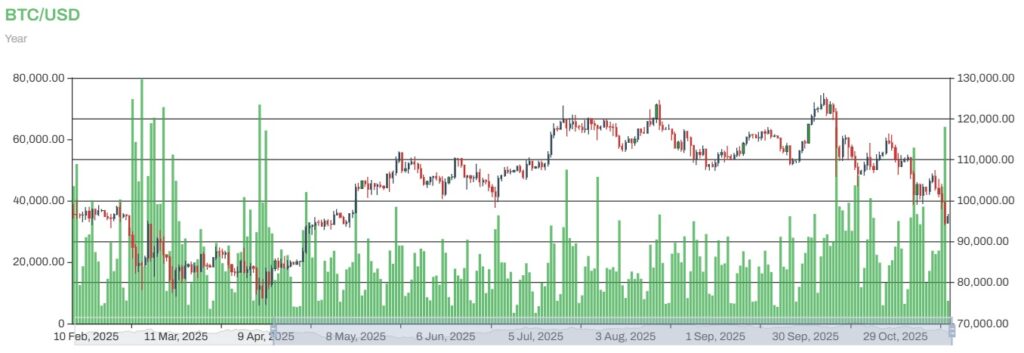
If Bitcoin wades through the Death Cross setup in the daily time frame after the exhaustion of selling pressure, buyers swooping in to buy the dip could lead to another price surge toward a recovery to $100K in the near term. It could also be a precursor to a last-minute rally in December to $150K-$200K, as some prominent analysts have projected.
Key Reasons Why Bitcoin Crashed
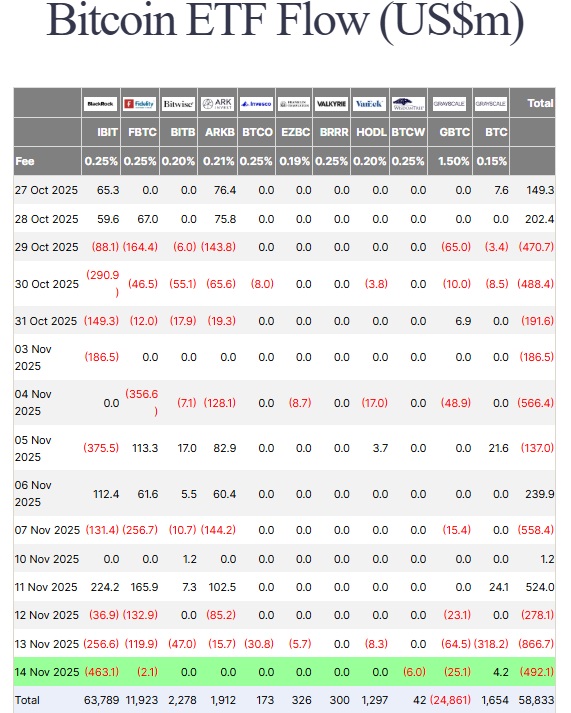
Bitcoin’s recent crash to $95K, which Tether CEO Paolo Ardoino called the “Bitcoin Black Friday,” was driven by a confluence of macro jitters. These include recession fears, the supposed AI (artificial intelligence) bubble, and a three-day streak of negative net inflows into the BTC exchange-traded fund (ETF) market.
However, one of the major narratives blamed for the FUD was the news that started gaining traction around Thursday and Friday that Strategy (formerly MicroStrategy) has begun selling a significant chunk of its multibillion BTC haul. The news substantially contributed to the already shaky market, adding roughly $1.36 billion to net outflows in spot Bitcoin ETFs on Thursday and Friday, on top of the $278.1 million net outflows on Wednesday.
The strong traction of the misinformation led Strategy Executive Chairman Michael Saylor to clarify that their company hadn’t sold a single BTC since they started accumulating in August 2020.
“We bought Bitcoin every day this week,” said Saylor to silence the FUD.
Disclaimer: The facts presented in this article are only for informational purposes. They do not serve as financial advice or product recommendations from the author or the Blockzeit team.
What’s your Reaction?
+1
0

+1
0

+1
0

+1
0

+1
1

+1
0

+1
0